Problem
Legal intake is high-friction for callers and high-risk for firms when urgency, jurisdiction, conflict checks, and advice boundaries are handled inconsistently.
R&D case study
Legal intake workflow that screens urgency, gathers structured information, and routes cases without inconsistent or unsafe responses.
At a glance
Delivery stage
R&D
Current state
Prototype
My role
Sole architect and backend engineer
Legal intake is high-friction for callers and high-risk for firms when urgency, jurisdiction, conflict checks, and advice boundaries are handled inconsistently.
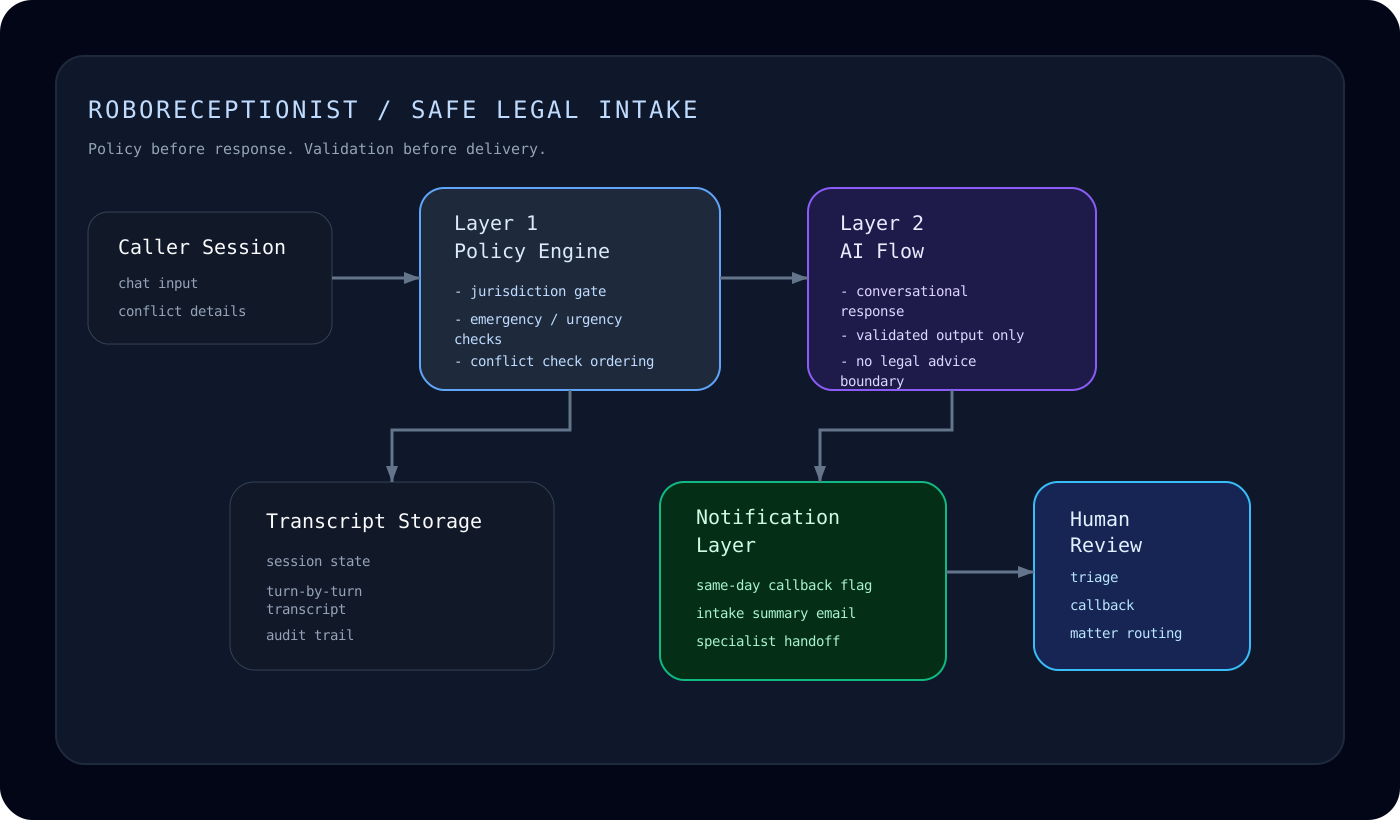
Built as a guarded intake architecture. A deterministic policy engine enforces jurisdiction, emergency, conflict, and legal-advice constraints before an AI layer can respond. Validated outputs are persisted with transcripts and routed to intake specialists through notification workflows.
Working prototype with policy-gated intake flow, jurisdiction detection, and conflict-check pipeline
This section shows the operational logic behind the build, not just the user-facing surface.
Core constraint
Validation and safety boundary: every LLM response must pass through a deterministic policy engine before reaching callers
This page separates what is already visible from what is still being prepared, so the proof layer can grow without pretending unfinished artifacts already exist.
Real artifacts stay visible. Missing artifacts are labeled directly so this page stays honest and ready for stronger proof later.
The system walkthrough is currently grounded in the intake flow and the architecture shown on this page.
The architecture diagram on this page is the strongest current proof artifact for how the system is structured.
This system has real operator-facing surfaces even at the prototype stage.
Current evidence is architectural and workflow-based rather than public-production proof.
More work at a similar delivery stage.
Proof surface in progress
Architecture / Flow
The current architecture direction is already clear even though the full artifact set is not published yet.
Weather-triggered signal and routing system in active development to turn storm activity into usable operational input for StormIQ.
My Role
Sole architect and engineer building the system foundation
Outcome
System boundaries are defined for signal ingestion, normalization, territory relevance, and downstream routing; implementation is in progress
Proof surface in progress
Architecture / Flow
The architecture direction is already concrete: stateful orchestration, controlled branches, and explicit review seams.
Workflow orchestration layer in active development for managing state, decision flow, and human review inside StormIQ.
My Role
Sole architect and engineer building the orchestration layer
Outcome
Execution model is defined for graph-driven workflow state, validation boundaries, and human review seams; implementation is in progress