Problem
Founders often start with broad ideas but no repeatable way to turn an industry choice into a realistic plan, staffing model, income assumptions, or startup sequence.
R&D case study
Planning system that turns broad startup ideas into structured, traceable business planning steps.
At a glance
Delivery stage
R&D
Current state
Prototype
My role
Sole architect and full-stack engineer
Founders often start with broad ideas but no repeatable way to turn an industry choice into a realistic plan, staffing model, income assumptions, or startup sequence.
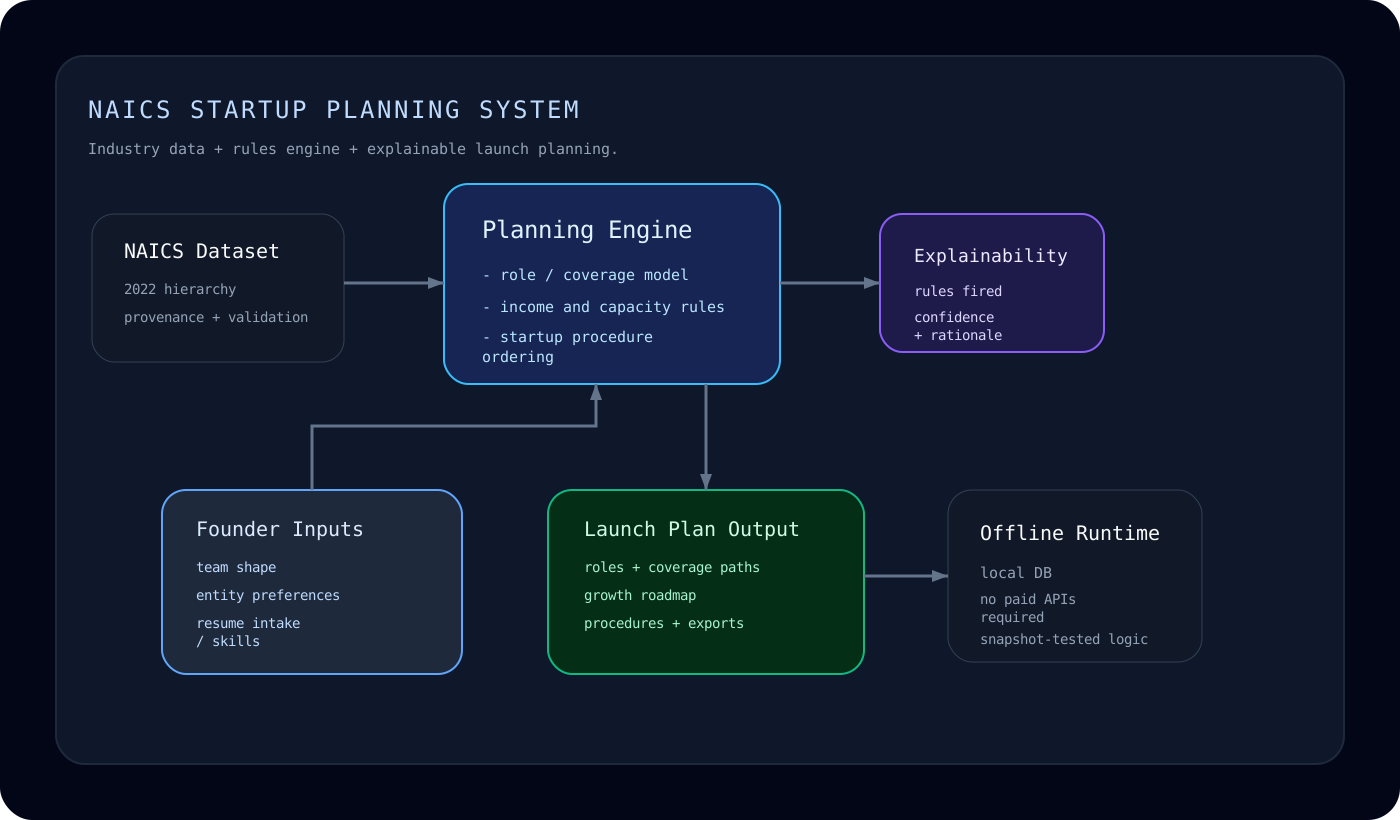
Built as an offline-first planning engine backed by the full NAICS hierarchy. The system combines rules-based role generation, income modeling, dependency-ordered startup procedures, and explainability views so users can inspect why each recommendation was produced.
Working planning engine with rules-based role generation, income modeling, and explainability views across NAICS hierarchy
This section shows the operational logic behind the build, not just the user-facing surface.
Core constraint
Explainability: every generated recommendation must trace back to a rule, data source, or constraint, not a black-box model
This page separates what is already visible from what is still being prepared, so the proof layer can grow without pretending unfinished artifacts already exist.
Real artifacts stay visible. Missing artifacts are labeled directly so this page stays honest and ready for stronger proof later.
The current walkthrough is grounded in how the rules engine turns category data into traceable planning output.
The planning engine diagram on this page shows how data, rules, and output generation are connected.
The system has clear operator surfaces even though it is still at the prototype stage.
Current evidence is centered on rules, diagrams, and generated outputs.
More work at a similar delivery stage.
Proof surface in progress
Architecture / Flow
The current architecture direction is already clear even though the full artifact set is not published yet.
Weather-triggered signal and routing system in active development to turn storm activity into usable operational input for StormIQ.
My Role
Sole architect and engineer building the system foundation
Outcome
System boundaries are defined for signal ingestion, normalization, territory relevance, and downstream routing; implementation is in progress
Proof surface in progress
Architecture / Flow
The architecture direction is already concrete: stateful orchestration, controlled branches, and explicit review seams.
Workflow orchestration layer in active development for managing state, decision flow, and human review inside StormIQ.
My Role
Sole architect and engineer building the orchestration layer
Outcome
Execution model is defined for graph-driven workflow state, validation boundaries, and human review seams; implementation is in progress