Problem
Lecture capture often stops at raw recordings, leaving transcription, summarization, storage, and retrieval fragmented across separate tools.
R&D case study
Audio-processing pipeline that turns raw recordings into transcripts, summaries, and reusable knowledge outputs.
At a glance
Delivery stage
R&D
Current state
Research System
My role
Sole architect and pipeline engineer
Lecture capture often stops at raw recordings, leaving transcription, summarization, storage, and retrieval fragmented across separate tools.
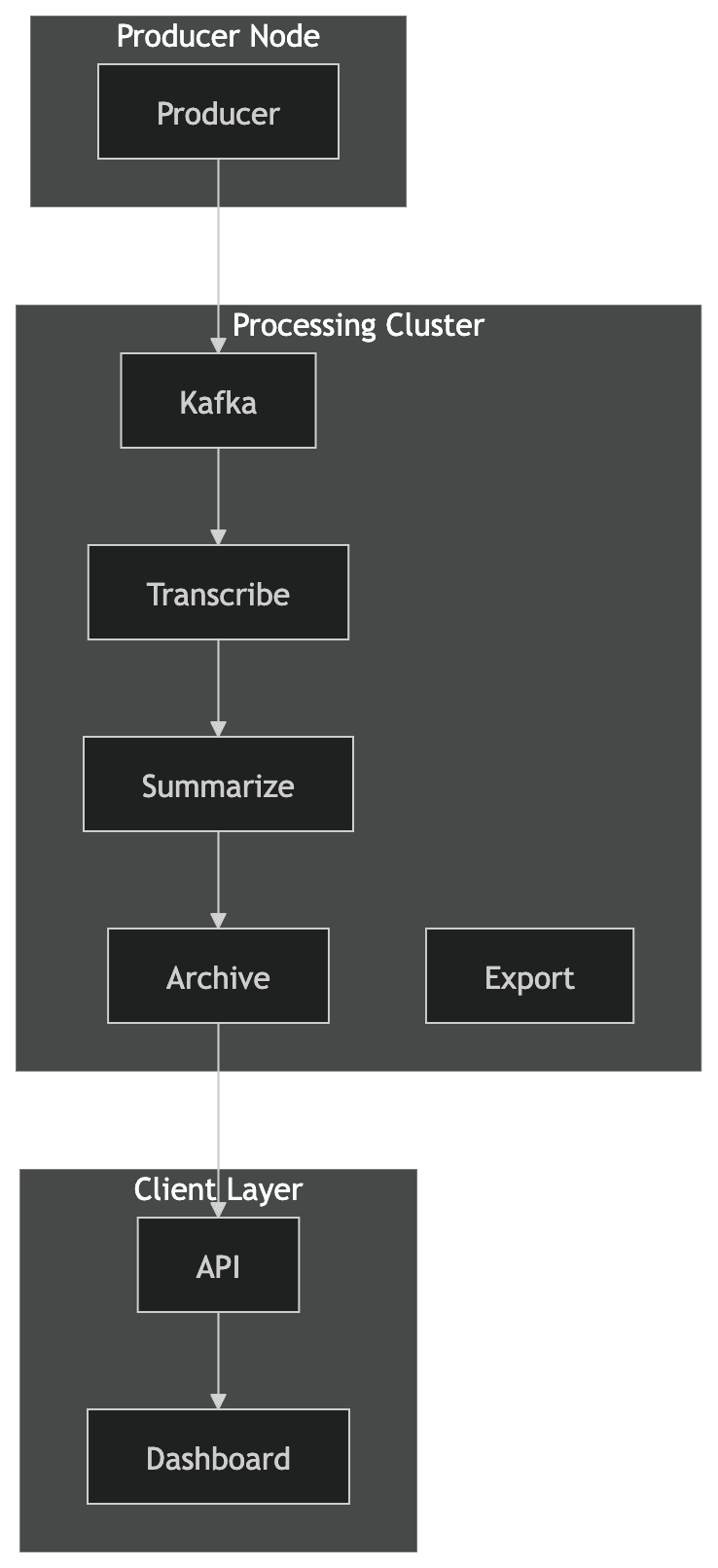
Built as an event-driven processing pipeline. Producer nodes upload audio into ingest services, Kafka fans work across transcription and summarization workers, archive services persist artifacts, and API/export layers expose transcripts and summaries as reusable outputs.
End-to-end pipeline processing audio through transcription and summarization to structured artifacts
This section shows the operational logic behind the build, not just the user-facing surface.
Core constraint
Event-driven decoupling: Kafka ensures transcription, summarization, and archival stages fail independently without data loss
This page separates what is already visible from what is still being prepared, so the proof layer can grow without pretending unfinished artifacts already exist.
Real artifacts stay visible. Missing artifacts are labeled directly so this page stays honest and ready for stronger proof later.
The current walkthrough is the pipeline boundary and processing flow rather than a public interface demo.
The boundary diagram on this page is the clearest proof artifact for how the pipeline is structured.
Even as a research system, the pipeline has explicit surfaces for capture, processing, and output handling.
The current evidence is process-oriented and technical rather than public-facing.
More work at a similar delivery stage.
Proof surface in progress
Architecture / Flow
The current architecture direction is already clear even though the full artifact set is not published yet.
Weather-triggered signal and routing system in active development to turn storm activity into usable operational input for StormIQ.
My Role
Sole architect and engineer building the system foundation
Outcome
System boundaries are defined for signal ingestion, normalization, territory relevance, and downstream routing; implementation is in progress
Proof surface in progress
Architecture / Flow
The architecture direction is already concrete: stateful orchestration, controlled branches, and explicit review seams.
Workflow orchestration layer in active development for managing state, decision flow, and human review inside StormIQ.
My Role
Sole architect and engineer building the orchestration layer
Outcome
Execution model is defined for graph-driven workflow state, validation boundaries, and human review seams; implementation is in progress