Problem
Lecture capture often stops at raw recordings, leaving transcription, summarization, storage, and retrieval fragmented across separate tools.
R&D case study
Audio-processing pipeline that turns raw recordings into transcripts, summaries, and reusable knowledge outputs.
At a glance
Context
R&D
Current state
Research System
Role
Sole architect and pipeline engineer
Lecture capture often stops at raw recordings, leaving transcription, summarization, storage, and retrieval fragmented across separate tools.
Event-driven decoupling: Kafka ensures transcription, summarization, and archival stages fail independently without data loss
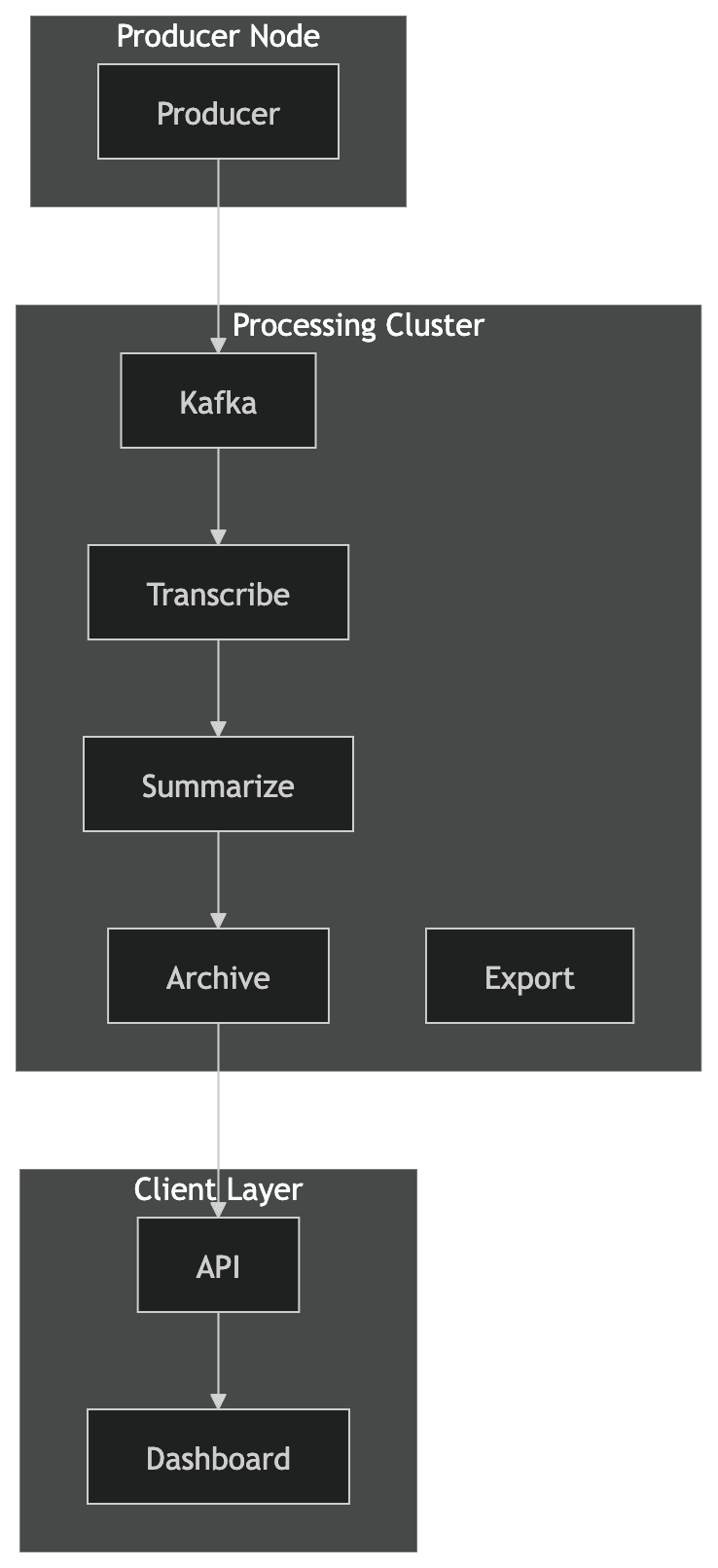
Built as an event-driven processing pipeline. Producer nodes upload audio into ingest services, Kafka fans work across transcription and summarization workers, archive services persist artifacts, and API/export layers expose transcripts and summaries as reusable outputs.
End-to-end pipeline processing audio through transcription and summarization to structured artifacts
The pipeline is shown as explicit stages so the system boundary is inspectable.
Where the pattern matters
Available artifacts are labeled directly. Missing visuals stay as placeholders until real screenshots are added.
The current walkthrough is the pipeline boundary and processing flow rather than a public interface demo.
The boundary diagram on this page is the clearest proof artifact for how the pipeline is structured.
Even as a research system, the pipeline has explicit surfaces for capture, processing, and output handling.
The current evidence is process-oriented and technical rather than public-facing.
What this does not claim
Reasonable next steps
More portfolio context.
A collaborative University of St. Thomas SEIS 745 project in which David Braun served as lead developer and primary implementer, turning large NOAA weather datasets into county-level risk views and decision-support reporting.
A small explainable Retrieval-Augmented Generation prototype that retrieves local evidence first, applies a relevance threshold, and refuses unsupported questions when the corpus does not justify an answer.